
Janes / By Jeremiah Cushman
Leonardo DRS has made international business expansion a strategic initiative in response to growing defence budgets around the world, Bill Guyan, senior vice-president for business development and president for international business for Leonardo DRS, told Janes on 14 July ahead of the Association of the United States Army’s (AUSA’s) LandEuro 2025 exhibition in Wiesbaden, Germany, on 16–17 July.
“I think that there’s also US policy changes encouraging more burden sharing with our allies and that’s also worked to help to accelerate their spending,” Guyan said. “We’re seeing an international defence market, almost all regions, growing faster than the US market,” he added.
The company’s approach resembles that of the traditional US national strategy of working with allies and partners, Guyan said. “It’s partners that make us strong as a company and so as a mid-tier defence company, as we look at the burgeoning international marketplace and all of those opportunities out there, these are opportunities for us to find partners and in many cases enable them to act as the prime going after programmes in their home country,” he said.
As countries spend more on defence, “they also want more and more domestic capacity. They want more organic capabilities”, Guyan explained. To compete for these increased opportunities, “we look to partner with nations and, if we can, enable a local [company] to act as the prime rather than to go into the market and try to take that role on”, he added.
BMS
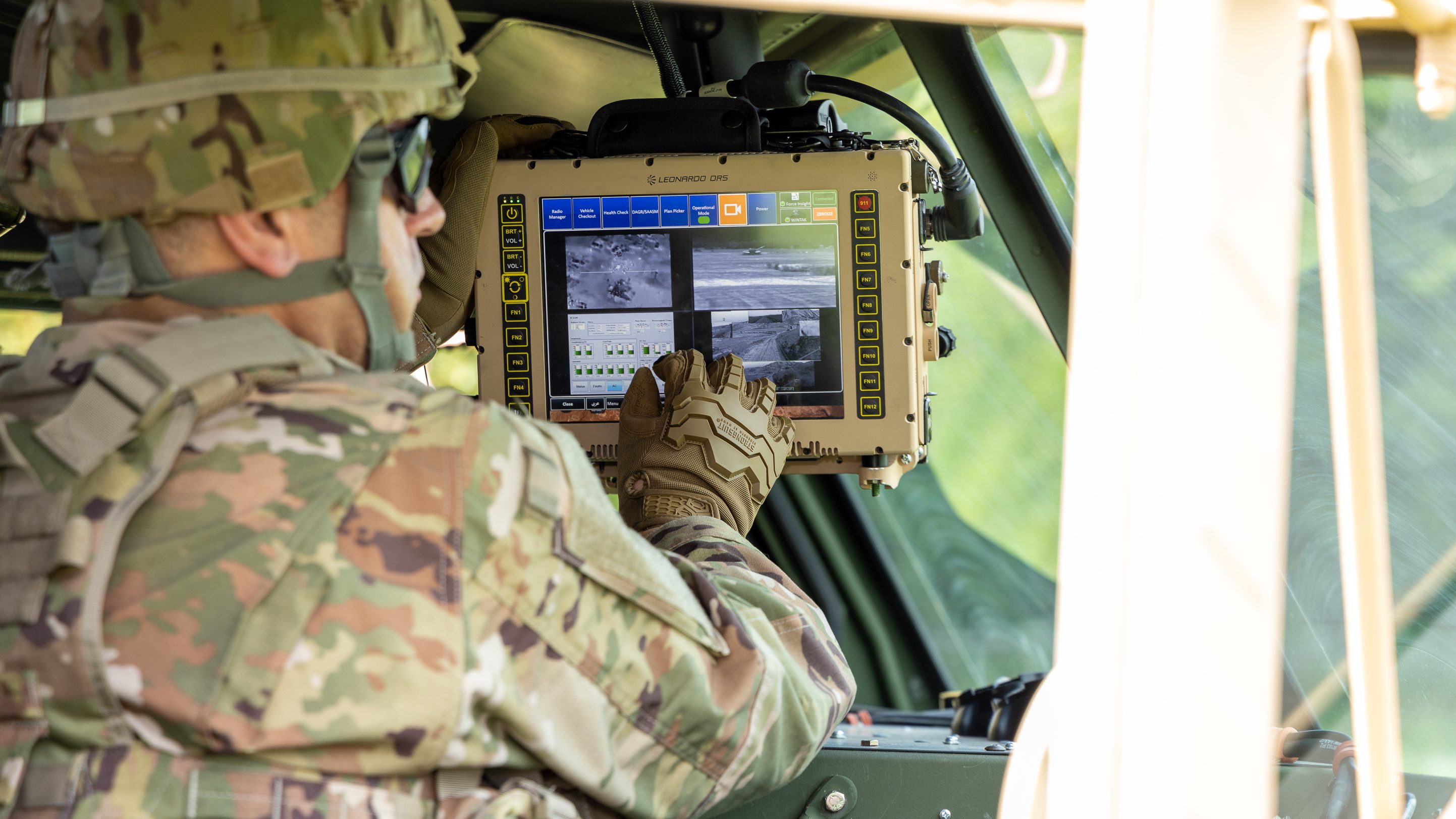
In Europe, Leonardo DRS sees opportunity for its battle management system (BMS) offerings, Guyan said, highlighting its “long-standing position in the UK” where the company continues to support the British Army’s Bowman BMS.
Leonardo DRS also serves as the system integrator for BMS capabilities for Polish and Romanian Abrams main battle tanks acquired through the US Foreign Military Sales (FMS) programme, he said. The company received the order for the Romanian BMS in December 2024, and is wrapping up the Polish Abrams BMS project, which began about two years ago, Guyan said.
At LandEuro 2025, Leonardo DRS will be looking for additional BMS opportunities, he said. “It’s increasingly table stakes to have a battle management system for an army, and there are still many that either don’t have one or don’t have one that works well. Furthermore, they don’t have one that is interoperable with the rest of NATO forces, so we think there’s still growth opportunity there,” Guyan explained.
“There are about 300,000 vehicles across the globe that have DRS computing and display systems in them,” he continued. “That’s the foundational position for DRS in the area of battle management. Beyond that, we’ve since gone into the integration business, and so in addition to providing the computers that run the software application for battle management, we also tie into the radios, any radios that the customer wants to use. We tie into the radios, we can cross-band different types of radios so that they can work together. We tie in the position, navigation, and timing capability that synchronises all the activity on the battle management system. And we also have the ability to tie into the sensors, which are on the platform so that commanders can see not only what’s around their vehicle, but also what’s on the moving map screen or the common operating picture,” Guyan said.
“We do the integration on the vehicle. We do the integration of the subsystems of battle management. And in the case of both Poland and Romania, we’ll do some training. We just finished training and deployment of [the] battle management system on the Taiwanese Abrams tanks that were delivered earlier this year,” he added.
The company has experience implementing BMSs with US and foreign radios and software, Guyan continued. “We’re agnostic to both the transport means and the software that’s underneath.” The Romanian army, for example, is using a locally developed BMS, while the Polish army is using software from Leonardo DRS partner Systematic, he said.
“We’ve got discussions going on with other nations where they’re trying to evaluate whether they should try to develop their own homegrown battle management system, or whether they should use something more off-the-shelf like the Systematic SitaWare line of products,” he said, calling BMS “a key area of growth” for Leonardo DRS.
“There’s desire for interoperability between forces and that’s the way we’re going to fight. Battle management systems will have to share data across national boundary lines in order for commanders to really know the status of forces and for us to be able to fight effectively. This is a high priority, I think, for the NATO countries,” Guyan said.
C-UAS
“Across the globe, we’re seeing maybe the fastest growth area of defence is counter-UAS [unmanned aircraft system],” Guyan said, noting Leonardo DRS supplies C-UASs to the US Army and Marine Corps, which could potentially be offered to allies through the FMS programme. He touted the DRS RADA C-UAS radar, which has been sold around the world.
“We’re seeing that everybody wants to know more about how they can, first of all, improve what they have, and secondly have a longer-term plan for both counter-UAS and in the longer term, some type of missile defence,” Guyan said.
He noted that there is greater awareness of the challenges posed by UAS, both on the battlefield and as asymmetric weapons, as demonstrated by Ukraine’s drone strikes on Russian bomber bases earlier in 2025. “In addition to the need to have detection, identification, and defeat mechanisms on the battlefield, there’s also a need to have the ability to defend critical infrastructure, both civil and military infrastructure, and we’re seeing that that’s an area of increased attention,” Guyan said.
“We think that for our business, having the best counter-UAS radar available means that we’re in the business of identification, and that can be used in a mobile way or in a fixed-site way. It’s perfect for protecting an airfield or for protecting troops on the front line. Our EO/IR [electro-optic/infrared] capabilities as a business allow us to translate the detected blip on the radar into something which we can see and identify and determine whether it’s a threat and how and when we might affect the shoot-down,” he explained.
“We’ve got mobile systems on armoured vehicles, on wheeled vehicles, and also we are delivering fixed tower-mounted systems for use at base defence and security,” Guyan added. “We think there’ll be a lot of attention with regard to these capabilities at the LandEuro [2025] show.”
For more information, please see Upgraded industry-funded directed energy C-UAS vehicle to appear in US Army training exercise .
Comment: Leonardo DRS is ramping up its international business strategy to take advantage of growing defence budgets around the world. At LandEuro 2025, the company is highlighting its BMS and C-UAS capabilities, with an eye on NATO front-line countries that are accelerating their military modernisation. Programmes with Poland and Romania provide a good foundation for further growth in the region.