
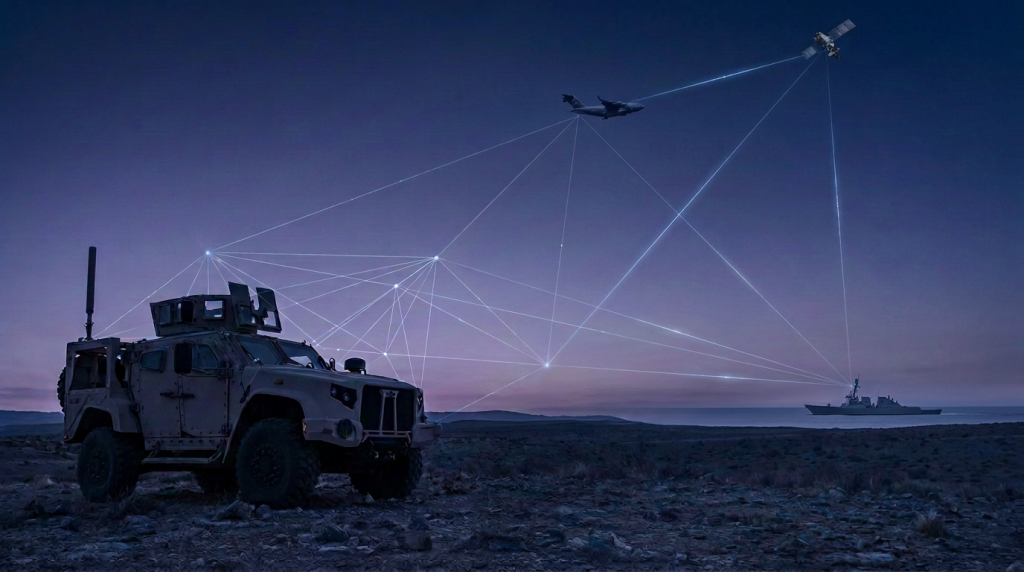
Artificial intelligence and machine learning help coalition forces get more from multidomain sensors and weapon systems: correlating data, tasking assets against the commander’s intent, and processing at the tactical edge fast enough to act inside an adversary’s observe, orient, decide, act (OODA) loop.
Modern defense platforms generate more data than warfighters can use. Radar, electro-optical and infrared (EO/IR) sensors, onboard systems, communications networks and other mission sources produce volumes that exceed both onboard processing capacity and the human ability to exploit them. The challenge is converting that flood into timely, usable information that supports tracking, targeting and mission decisions.
AI and machine learning matter when they improve how sensors process data and how mission systems correlate and present it under real operational constraints. In contested or fast-moving environments, that means better sensor performance, lower latency, cleaner fusion, sharper prioritization of relevant inputs and less work for the operator.
Faster Processing at the Tactical Edge
Many sensing tasks are time-sensitive and bandwidth-constrained. Sending raw data off the platform for processing introduces delay and creates dependence on networks that may be degraded or unavailable when they matter most.
Running AI workloads on ruggedized edge computers changes that timeline. Processing happens at or near the sensor, which cuts data-transfer demands and transport delay while maintaining continuity when connectivity is limited. Mission systems can ingest data, run inference and update displays or decision-support functions on the tactical platform itself, where decision speed matters most.
The operational payoff:
- Lower latency from sensor input to system response.
- More continuity in denied or degraded environments.
- The capacity to handle multiple events or targets locally.
- Faster interpretation of what is happening in persistent DDIL conditions.
Edge processing also reduces size, weight and power (SWaP) demands on weapon systems while improving mission execution.
But AI is not perfect, so before fielding autonomous target recognition, Leonardo DRS builds trust-evaluation methods the industry needs as evidence that a system’s decisions can be relied on before it perceives, learns, decides, and acts in real time, all within the SWaP-C constraints of tactical platforms.
Sidebar: How to Measure AI at the Edge
| Consideration | Why it Matters | What is Measured |
| Model accuracy | Drives mission success | Accuracy of predictions |
| Throughput | Determines whether the system keeps up in real time | Inferences per second |
| Latency | Sets decision speed and reaction time | Time between input and output |
| Energy efficiency | Power and thermal limits decide what can run at the edge | Inferences per second per watt |
| Hardware utilization | Edge computing resources are limited and directly affect mission success | Cost per inference at a given accuracy |
Decisive Sensor Fusion and Mission Processing
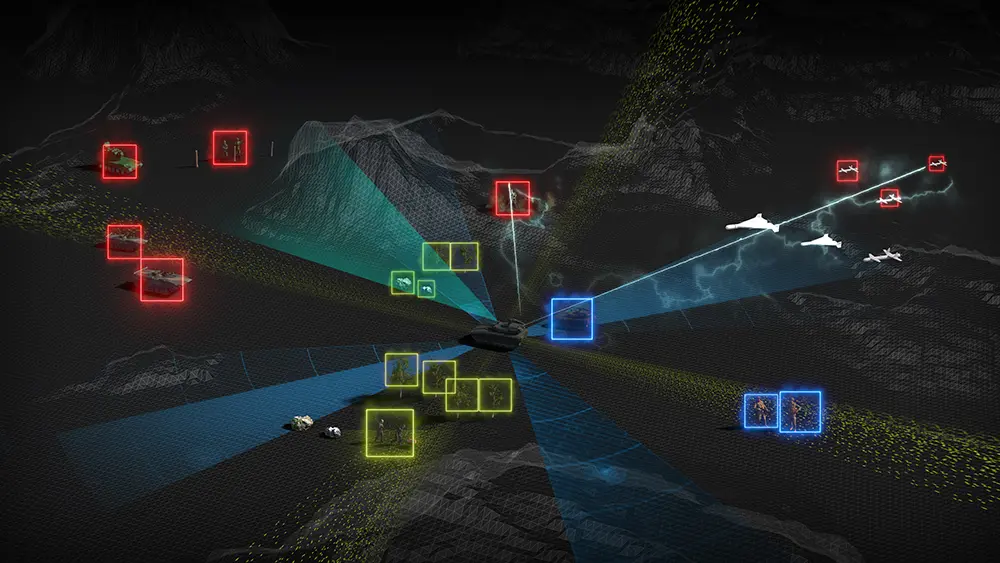
Mission systems are only as effective as their ability to combine inputs from different sensors and present them in a form operators can act on. Leonardo DRS’s SAGEcore™ Software platform shows what that looks like in practice: radar, passive RF, infrared and intelligence feeds processed in parallel into real-time, actionable view of the tactical battlespace, instead of separate feeds an operator has to reconcile by hand.
AI and machine learning cut the manual burden of sorting high-volume data streams this way, accelerating correlation between activity across the electromagnetic spectrum and events in the battlespace, and prioritizing intelligence, surveillance and reconnaissance tasking toward what the force does not yet know.
A mission-processing architecture built this way delivers:
- Faster correlation of detections across sensors.
- Relevant threats, anomalies and changes elevated for review.
- Fewer hours spent manually combing through imagery and sensor data.
- A faster transition from detection to tracking and decision support.
- Earlier identification of mission risks and force vulnerabilities.
The result is a more robust and timelier common operating picture (COP), data turned into useful information and actionable knowledge fast enough to stay inside the enemy’s OODA loop.
Smarter Displays, Lower Operator Burden
Back-end processing delivers value when it improves what the crew sees and how quickly they can interpret it. Fuse camera, radar, thermal and electromagnetic-spectrum data with off-board inputs, run it through an AI model that reasons across space and time, and the operator gets decision-quality information and battlespace knowledge instead of a wall of separate feeds.
Crews spend less time reconciling screens and more time assessing what matters.
At the system level, that means:
- Fewer disconnected inputs to interpret.
- Faster recognition of relevant changes or threats.
- A lower cognitive burden on crews and commanders.
- More responsive interaction with mission data.
Integrated smart displays also trim a platform’s SWaP burden.
Open Architecture Supports Upgradeability
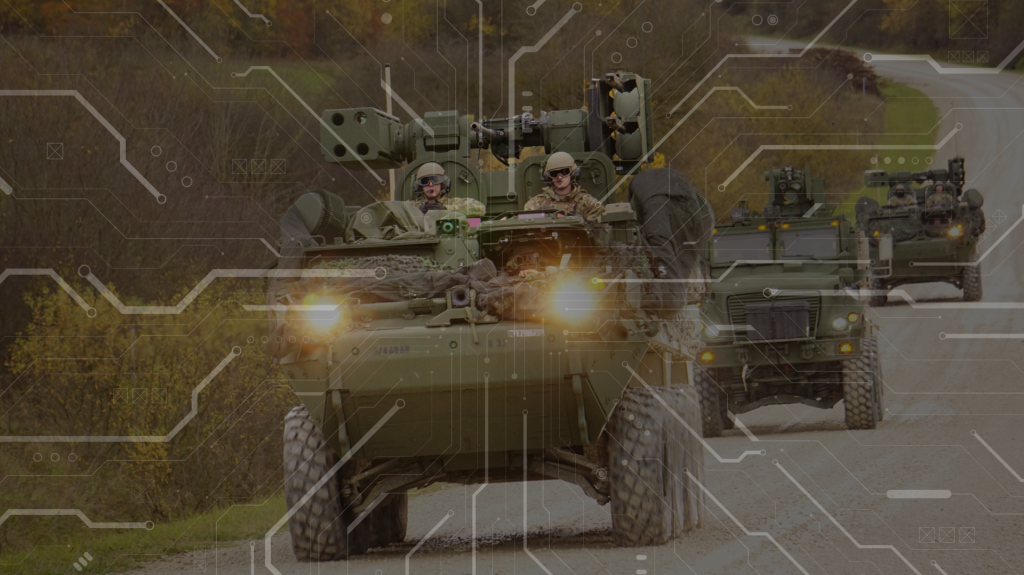
Mission requirements will keep evolving, and so will sensors, computing demands and AI applications. Open-architecture mission computing lets systems adapt without a full redesign or extensive re-integration.
Embedded computing aligned with open standards supports:
- Technology insertion.
- Cleaner integration.
- Interoperability.
- A more sustainable upgrade path over time.
That matters to the warfighter in changing mission environments, where new sensing, processing and mission applications must be integrated and fielded quickly.
A Practical Modernization Story
The credible AI story in defense is measurable change in mission-system performance: lower latency, faster correlation, better continuity at the edge, improved operator awareness and reduced workload.
Applied this way, AI and machine learning strengthen traditional sensing and mission systems, letting platforms process more data, build a clearer picture of the environment and support faster, better-informed action under operational conditions.
Leonardo DRS AI and Machine Learning Capabilities Across the Mission System
These operational effects map to specific Leonardo DRS technologies already fielded or in development across sensing and mission systems:
- SAGEcore™ fuses AI, sensors and edge computing into one deployable platform, processing radar, passive RF, infrared and intelligence feeds in parallel to build a shared real-time view of the battlespace. SAGEcore is available for ground, naval, airborne and spaceborne platforms.
- Artificial Intelligence Processor (AIP) brings advanced processing power to Army ground vehicles, supporting battle management, targeting, vehicle protection and logistics applications.
- THOR provides the open-architecture computing and sensing backbone, aligned with the Sensor Open Systems Architecture (SOSA) standard, that runs the AI workloads, using SAGEcore™ to fuse multi-sensor data and enabling upgrades at the speed of need.
- Rugged Smart Displays – Ground (RSD-G) present integrated mission information to vehicle crews through a ruggedized display environment, fusing camera, radar and thermal inputs into a single display view.
- Mission Command Systems tie sensing, computing and displays together into scalable, platform-agnostic networking and battle management systems.
Together, these technologies form a continuous chain from sensor to decision. Edge computing processes data close to the source, open architectures keep systems current, and integrated displays help crews assess mission information more efficiently.
That is what practical AI looks like in defense operations: not a single model but a connected set of systems built for tactical missions to cut latency, improve awareness and support faster, better-informed action.
By connecting sensing, computing, software and mission systems, Leonardo DRS helps customers Own the Edge™ — building a common operating picture that earns its name, and mission advantage that holds up in complex, contested environments.
Related News
Contact
Media Inquiries
For any further information