
Overview
We routinely design, develop, and qualify full scale Commercial Off-the-Shelf (COTS) based payloads for the maritime environment as specified by the associated mil standards (e.g., shock, vibration, power, noise, and EMI) supporting deployment of COTS hardware in both forward-fit and back-fit applications.
With computing becoming denser more shipboard power is required to operate the hardware; as well as additional heat is created. To account for these changes, we leverage existing and new designs, models, products, and tools to accelerate the timeline to qualification and delivery.
Shipboard Cabinet
We team with our customers to design and qualify a shipboard cabinet that enables your hardware to perform its best at sea.
To complement our approach our established vendor relationships, provide specific engineering discipline and production services to solve the toughest development, design, and production scenarios quickly and efficiently. For example, we utilize copper microchannel HEXs that offer improved corrosion resistance, strength, and conductivity as compared to aluminum improving the thermal performance (up to 5x) as compared to legacy tube-fin HEXs used in legacy cabinets.
- Small form factor cooling solutions (water 15kW, air 5kW) that increase the thermal load by 5x over legacy cabinets.
- Modular power components to provide primary power conditioning and distribution, achieving enhanced power capacity as compared to legacy shipboard cabinets.
- Advanced mechanical hardware including slides and shock / vibe isolation techniques.
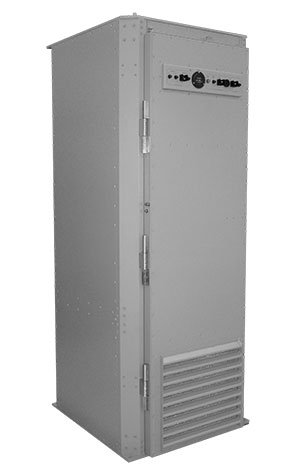
Open Modular Cabinet (OMC)
Cabinet for Life
Leveraging our 25+ years supporting U.S. Navy shipboard C4ISR, Leonardo DRS has developed a solution for mission critical computing cabinets. Building upon our current support of the Integrated Combat System (ICS) Infrastructure-as-a-Service (IaaS) equipment, our next generation solution offers a “Cabinet for Life” approach that enables PEO IWS to meet the objectives of the Foundry, including Continuous Integration/Continuous Deployment (CI/CD).
The Leonardo DRS Open Modular Cabinet (OMC) is based on industry’s Open Compute Project (OCP) standards and ecosystem that is supporting all industry data centers. The OMC specifically tailors OCP Open Rack Version 3 (ORV3) standards to meet the unique requirements of the shipboard environment while continuing to support legacy compute needs enabling a Cabinet for Life.

Mechanical & Environmental
- EMI-sealed cabinet enclosure
- Provides kinematic isolation for COTS payload from shipboard environment.
- Fits in the same footprint as current Mission Critical Enclosures.

Payload Flexibility
- Supports 19-inch EIA rackmount, 21-inch wide high-performance computing (HPC) and artificial intelligence (AI) systems, and hybrid solutions.
- Modular platforms using Open Architecture interfaces enabling pier-side upgrades and baseline

Power & Cooling
- Supports 18 kW plus power with 97.5% efficiency
- Supports direct liquid cooling, air-assisted liquid cooling, and efficient heat exchangers
- Capable of supporting standard air cooling
- Mil-Std-1399 qualified Powershelf
- 48 VDC bus bar and payload blindmate connectors eliminate power cabling to payload

Maintainability & Operations
- Payload equipment configured with front I-O to reduce cable management complexity thus keeps maintenance to the front of rack
- Blindmate power connectors support hot-swappable power supplies and server LRUs.
- Software includes common operating environments and functional services.
OMC Operational Benefits
- Lower complexity and sustainment cost: Resolves legacy computing infrastructure complexity and sustainment costs.
- Legacy compatible and future ready: Supports legacy 19-inch systems while enabling HPC servers and AI support hardware.
- Reduced installation, maintenance, and upgrade times: Lowers cost and schedule for installation, maintenance, and upgrades.
- Mission-tailored pier-side reconfiguration: Enables rapid modification of hardware infrastructure for specific mission needs while in port.
- Designed to keep shipboard tactical data centers aligned with industry computing advancements: Supports increased compute density to meet evolving Shipboard Datacenter performance needs.
Why OMC Now? Industry Trends and Navy Benefits
| Trends | Benefits to Navy | Metrics |
|---|---|---|
| Scalability and flexibility 1 | OMC modularity enables pier-side scaling and upgrades without hull cuts. | Integration time ~30% faster
Fielding costs ~25% lower Sustainment ~20% lower |
| Cost efficiency 2 | OCP alignment and reduced vendor lock support lifecycle affordability while maintaining legacy compatibility. | 30% to 40% capex reduction
~20% OpEX reduction with OCP standards |
| Energy efficiency 3 | OMC supports higher density payloads and advanced cooling options to manage shipboard power and thermal constraints. | Average PUE 1.15 vs 1.58
25% lowered sustainment costs due to reduced energy and cooling |
| Standardization and interoperability 4 | OMC tailors OCP ORV3 for shipboard use to simplify integration and refresh cycles across platforms. | Integration timelines reduced to 25%
Sustainment reduced to 20% with standardization |
| Innovation and rapid deployment 5 | OMC supports rapid insertion of new payloads including HPC and AI hardware during in-port periods. | ~50% faster deployment cycles using flexible OCP hardware |
| Enhanced security 6 | Open standards improve transparency and speed of security improvements, reducing time to field secure capability. | 58% report enhanced visibility/control
Features integrated 20% faster 20% Reduced long-term security costs |
| Vendor diversity 7 | OMC reduces dependency on single suppliers and supports competitive sourcing and sustainment options. | 25+% increase in Vendor diversity
Reduced supply chain disruptions by 15% Reduced integration timelines by 15%. |
| Global adoption 8 | Alignment with globally adopted standards leverages proven designs and best practices, accelerating modernization. | OCP adoption reached 60 percent in hyperscale in 2022; timelines -20 percent; sustainment -15 to 20 percent. |
1. Metrics based on IDC Report (2022); 2. Metrics based on Gartner Study (2023); 3. Metrics based on Uptime Institute Global Data Center Survey (2023); 4. Metrics based on HIS Markit Report (2023); 5. Metrics based on McKinsey & Company (2022); 6. Metrics based on Ponemon Institute (2023); 7. Metrics based on 451 Research (2021); 8. Metrics based on Synergy Research Group (2022)
Videos
Show All
Related Products & Services



Related News
Contact
John Reichl
Senior Director, Business Development Naval Electronics
For any further information